There should be a well-defined place for everything and everything should be in its place, is central to housekeeping services. With the growth of the hospitals in the private sector, particularly the emergence of corporate culture in hospital, more and more importance is being attached to the house keeping services. The concept of housekeeping service has originated from the hotel industry, but it has become a basic requirement of the hospitals also. The clean aesthetic and hygienic environment play a great role in attracting the customers, their retention and also in their delight. It is not only restricted to the external customers or end users of the services but also to the internal customers of the hospital. The internal customers of the hospital are doctors, nurses, paramedical staff and auxiliaries. Soothing and comfortable environment increases efficiency of the staff of the hospital. In bonus it is responsible for the patient satisfaction, in turn increased utilization rate of the hospital services. In nutshell, all hospital activities directed towards a clean, safe, hygienic aesthetic and comfortable environment is called hospital housekeeping.
Housekeeping services started in the middle of 17th century. Florence Nightingale also emphasized the need of good housekeeping services. In 1960 the hospital housekeeping services were recognized as a separate discipline. Now with recognition of the quality assurance program a new housekeeping technique has been developed by the name of “5 S” technique. The “5 S” technique of housekeeping is gaining importance for application to other fields of the industry. It is equally applicable in the hospital housekeeping services.
The main functions of the house keeping services are:
The housekeeping services can be broadly divided into:
1. In house Services: The staff is recruited by the hospital and the services are maintained by the hospital housekeeping services.
2. Outsourcing: Either the hospital housekeeping services are handed over to the third party for maintenance or the private party on out source is engaged for providing the housekeeping services to the hospital as per the requirement. There are distinct advantages of the outsourcing:
a. Relieves the hospital managements from burden of housekeeping.
b. Expertise in interior decoration or in other areas may be hired as and when required basis, so it will not be a permanent liability of the hospital.
c. Reduction in cost of staffing from recruitment to retirement.
d. Reduction in cost of maintenance of equipment’s and materials.
Housekeeping Activities
a.Basic Cleaning:
i. Dusting
ii. Sweeping
iii. Mopping
iv. Polishing
v. Washing
b. Cleaning of the Physical Facilities:
i. Floors
ii. Walls and ceiling
iii.Door and window panel
iv. Furniture and fixtures
v. Equipment’s.
2. Odour Control
3. Hospital Waste Disposal:
a. Collection
b. Transportation
c. Disposal
4. Pest & Rodent Control
5. Control of Stray animals
6. Hospital Linen Supply.
a. Procure from store
b. Storage
c. Maintenance
e. Issue to units
f. Accounting sorting, segregation and sending for cleaning.
7. Housekeeping equipment maintenance
a. Proper placement
b. Dusting
c. Sweeping
d. Mopping
e. Polishing
f. Washing
g. Covering while not in use.
8. Management Task (POLICE TASK):
a. Leadership and Liaison
b. Implementation
c. Controlling
d. Evaluation
e. Team work that is “total effort of all members” (TEAM)
f. Attitude
g. Skills
h. Klowledge
Following cleaning agents are generally used in hospitals:
A good house keeper has to be a hard task master. Task means, he must possess qualities of working in a team and with positive attitude, with skill and knowledge, what the brain does not know eyes don’t see. It varies from person to person. The house keeper must be a good interior decorator. The abilities of the house keeper should be:
The housekeeping services department is a labour-intensive department. It uses modern, up-to-date equipment, but the job of cleaning the patient rooms, corridors, and lobbies of the hospital falls to the labour force, made up primarily of cleaners (maids and porters). The administrative head of the department may be the housekeeper or chief housekeeper. The maids are assigned light cleaning, dusting, and mopping of the floors. The porters usually do the heavy housekeeping and the furniture moving. By the nature of the cleaning process, the maids have an impact on patients in two ways. The results of their work (that is a clean nursing unit or patient bedroom) have both a public relations and psychological effect. The maids’ approaches, professionalism, attitudes, and personalities directly affect the patients, since they come in constant daily contact with patients while cleaning their rooms. A cheerful, well-informed polite maid can add a great deal to the total image of the hospital.
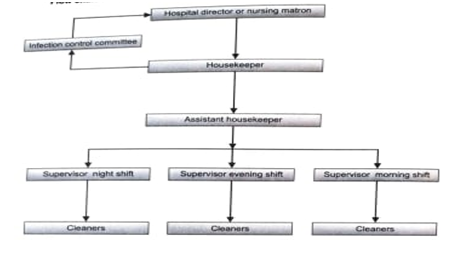
Housekeeping service unit has interdepartmental relationship with all the areas of the hospital as it renders cleaning service to every nook and corner.
| Inter departmental relationships of housekeeping service unit | ||
| 1 | Laundry | Solid linen delivery & clean linen recipients |
| 2 | Incinerator | Disposal of combustible waste material |
| 3 | Infection Control | Infection control procedures are carried out by housekeeping unit |
| 4 | Wards | Cleaning patient room after discharge or transfer of a patient & making it ready for another patient |
6. Soiled linens need spot-checking for misuse and stains.
7. Clinical laboratory tests made to identify bacteria on surfaces such as door knobs and handles.
Whenever a patient is infectious and has to be moved into isolation, the housekeeping department must properly disinfect the patient’s room and remove infectious and hazardous wastes. The department interfaces directly with the infection control committee’s policies on disinfecting a given area or room, using special bacterial solutions and certain misting or other kinds of techniques that have proven effective in disinfecting accommodations. Usually infectious wastes are placed in specially marked bags and double bagged. Incineration is the most efficient and cost-effective method to dispose of infectious wastes. Legal requirement of hazardous waste removals varies from state to state. The removal of hazardous wastes such as carcinogens and radioactive materials is regulated by local, state, and federal agencies. Many state laws concerning hazardous waste follow the Federal Environmental Protection Agency regulations. The environmental services department must keep informed of changes in the regulations. Hospitals may have on-site removal mechanisms such as incinerators or may contract with firms to provide waste removal services. The hospital as the creator of hazardous and infectious wastes is liable for safe and removal of these products.
An important factor in linen control, especially in guarding against pilferage, is that hospital linen should be properly marked. Linen marking (that is a hospital name or logo woven or stamped on to the items) is a very effective means of reducing the temptation to people to take linens home with them. In case of the linens and sheets, decals can be affixed to the items. It is common for hospitals to use different coloured linen throughout the hospital. For example, the operating room may use green, and medical-surgical nursing units may use white. There are two methods of distributing linen to the nursing units. Clean for the day should be on the nursing floor ready for use not later than the first shift. The distribution itself is usually handled in a centralized fashion in which one more large linen carts are regularly rotated around the nursing units from floor to floor. Another method of distributing linen, the decentralized way is to provide each nursing unit with its own separate linen cart. With this method, a nursing unit may have a small supply of emergency linen on the floor. But the bulk of linen is kept in the carts usually under lock and key.
Having good technologically advanced computerized services in the hospital is useful in many ways to all the departments.
Keeping hospital clean is not an easy task. Part of the problem is that a hospital is an active place open 24 hours a day, every day of the year. Frequently the heavy traffic areas need special attention; if they are not cleaned, they can give a negative image to the entire hospital. There is more to cleaning a hospital than simply making sure that each room and floor are cleaned properly under the right standards. Cleanliness for hospital patients, visitors and the staff has two side effects: it creates a public relations image, and it has a psychological effect on the patients and their visitors. A clean hospital is perceived to be a well-organized and well-run hospital and secondly it can reduce the probability, possibility and potentiality of infection.
The hospital housekeeping services serve all the departments of the hospital, as far as possible, it should be centrally located and close to the vertical transport system of the hospital. The following facilities are required in housekeeping service:
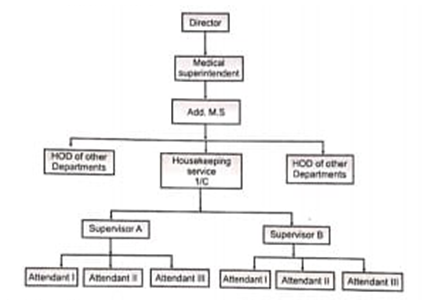
It is a real guide to a new recruit as well as to the hospital to train the housekeepers. These parameters not only include duties and responsibilities but also the reporting relationships, authority and control. This will also include how to coordinate with other departments, status within the departmental hierarchy, etc. The hospital administration must hand over the job description to every new recruit to make them aware about the job responsibilities. It has got several advantages:
Common equipment’s used in housekeeping services are:
Due to the increasing need of housekeeping services in the modern hospitals, new advancements are being introduced in respect of technology and techniques. Some of these are being enumerated and discussed below:
Japanese in their language call these steps as SEIRI (Sorting), SEITON(Segregating), SEISO (Shine/ sweep), SEIKETSU( Standardize) and SHITSUKE (Sustain/self discipline).
Housekeeping is one of those services whose efficiency, or lack of it, can be seen in any area/department of the hospital. Shining floors, clean dust free walls and ceilings always inspire confidence whereas dirty filthy corridors, stinking toilets and insect nuisance not only offend the senses but also discourage the patients/visitors. Apart from the visual effect an unclean environment has a direct effect on the hospital infection rate.
Quality of house keeping service depends largely on the quality of process used. All that it needs is a trained, motivated workforce, standardized cleaning and disinfection procedures (and schedules) and adequate good quality cleaning materials. Modern equipment, if available, may enhance the quality of shine on the floors. However, one must realize that dirty areas are often the areas where machines cannot reach and men won’t care to.