
The hospital is an integral part of a social and medical organization the function of which is to provide for the population complete health care, both curative and preventive and whose outpatient services reach out to the family and its home environment, the hospital is also a centre for the training of health workers and for bio-social research. The hospital is a subsystem of a larger social system. The hospital subsystem again consists of various subsystems, like clinical services diagnostic services, therapeutic services support and utility services. The present-day hospital not the same as it used to be during early ages. The present-day hospital is not only a centre for medical care but also takes care of the various aspects of hospitality management. A star hospital of today provides high tech medical care and beyond that the star facilities of a star hotel. The hospital is very labour-intensive organization that mobilizes the skills of widely divergent group of professionals, semi- professionals and non-professionals to provide highly personalized services to individual patients.
The hospital has got direct access to any body and virtually any time of the day. The shopping malls may have security checks for all the entrants, but it is rarely seen in hospitals. Following are the two brief stories not about India but about the developed countries, which try to emphasize the need of security and safety arrangements in our hospitals. This will also emphasize that the hospitals are very soft targets. At one hand we are trying to develop medical tourism and encouraging foreign nationals to come for treatment and tourism and the other hand there might be perceived threat also. Then how to strike a balance? How to organize the security system? How to make the security system effective? How to modernised the security services of our hospitals? These are really causes of concert in times to come.
The critical assets of the hospital as well as the critical areas, need special emphasis while planning for the hospital security organization. The critical assets of the hospital as well as the critical areas, need special emphasis while planning for the hospital security organization.
Critical assets to be considered in the hospital security planning are:
Before making a security plan for the hospital it would be a prerequisite to understand the role of the security services in the hospital. This will also help in the job design and job specifications of the hospital security services.
Health Care Workplace Violence Prevention and Response Processes and Training. Development of Hospital Security or Workplace Violence Policies, Plans and Procedures, including Security Management Plans. Enhancement or Development of Hospital Security Officer/Police Programs, whether contract, proprietary, sworn officers or hybrid, including Training Programs; creation of Post Orders; Contracts, Scopes of Work, Job Descriptions, or Specs, etc. Note that security staff is typically the costliest, and sometimes problematic, aspect of the security program. There is much that can be done to better assure a more cost effective and consistently professional and customer service focused security force.
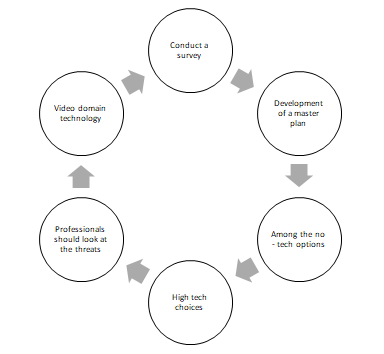
The age-old method of crime detection, prevention and control is effective and there is no substitute for it, but at the same time the crime has also become very technical due to advances in technology. Unless the security organization also keeps up dated about the technology, the crimes may go un-noticed or difficult to detect and control. The hospitals are high tech, the equipment’s are high tech, the criminals have also become high tech then, there is no option except to develop high tech system for crime detection, prevention and control.
The methodology of development of a security plan for the hospital will consist of the following steps:
Hospital security is a unique challenge. Consider the variety of people who make up the typical hospital environment – patients, staff, vendors, physicians, visitors and even their enemies. Consider the place many different rooms and spaces, high-value equipment, accessibility to drugs, many entrances and ease-of-movement around the building and premises. It all adds up to a need for different approaches to security. Hospital managers base their security decisions on law, costs, and fear of litigation, and to protect their facility’s reputation. But the critical assets of a hospital-its people, property, information and reputation must be protected with good security. The main threats in a hospital environment; as insider/ threats against patients or staff, and crimes of opportunity
a. Alarm systems
b. Access control systems
c. Photo identification
d. CCTV
e. Two-way voice communications
f. Weapons screening systems.
New tools such as:
a. Patient locators video pursuit software
b. Delayed egress hardware
c. Active asset control systems
d. Enterprise-wide systems Digital video and pager alarms can enhance security even more
a. The emergency/trauma department (gang fights, vendettas, domestic conflicts, child custody conflicts, VIP patients)
b. Infant care area (infant abduction, need for CCTV and infant security).
c. Pharmacy/drug storage area (alarm and access control systems) iv. Prisoner care area (receiving, elevator lock-off, surveillance, command centre).
d. Operating rooms (access control, delayed egress hardware, CCTV)
e. Labs (access control, duress alarms, CCTV)
f. Nuclear medicine areas (access control, CCTV)
g. Geriatric care area (patient locators CCTV)
h. Psychiatric care area (lock-down capability, access control, staff duress, solitary room).
i. Morgue (decedent services area, access control, alarm system, CCTV), and
j. PBX area (late-night security, rest room security, door release, duress alarm)
The manual workers are very costly and at the same time the human element of management is always associated with it. The video monitoring system is cost effective in comparison to, the manual monitoring with the help of security guards. Though the initial cost of video monitoring system is much higher in comparison to the recruitment of the manual workers but the long-term benefits are definitely more with the advanced technology: To cope up with the increasing threats of different types to the soft organization like hospital, we must develop a technologically advanced system for security of the hospitals, One of such technology is video domain technology which has been successfully installed in some hospitals. This technology has got a centralized control system located at the administrative centre and installing a system in all the hospital areas. The control centre can monitor after hour-entry at the hospital areas or centre via remote video.
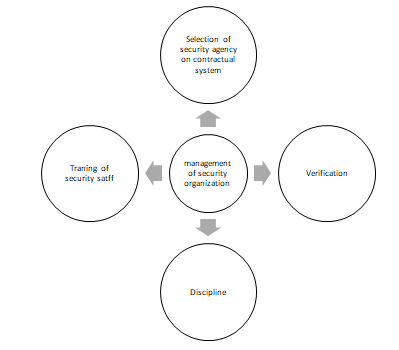
How the security organization is to be managed? It is million-dollar question. At one hand there is an increasing trend of going for contractual system. It leads to another problem, whether the security is to be fully privatised of some supervision and control at the top level is to be retained and maintained as an internal organization of the hospital.
a. Short listing of agency.
b. Establishing bid specifications
c. Submission of bids
d. Evaluation of bids
e. Final selection of agency.
a. Absence without permission
b. Alcohol abuse/drug abuse
c. Failure to report incidences/false reporting duty
d. Sleeping while on
e. In subordination
f. Corrupt practices like bribery.
a. Induction training
b. On the job training
c. Refresher courses
d. Training on technology updates
e. Training on surveillance system of crime
f. Security awareness programs
g. Administrative training of officers.
The security staff may be public, private or mix of these two, have to perform all such duties where enforcement of law and order is required, since this is a very sensitive issue as it invites controversies many a times from human rights commission, women rights, judiciary and executive. Under such circumstances the enforcing authorities have to work within their limits. This is more relevant in case of the security agencies which are totally private. It is very essential to mention certain important provision under the law of the land.
These are:
The security officials do not enjoy the authority to arrest and detain; this authority is vested with civil authorities. All major incidents of theft, accidents, and other offences must be reported to the police in the form of First Information Report.