
Planning is considered the first primary function of management. In this function, managers define the organizational goals and allocate resources of the organization to achieve such goals. So, planning will also define all the future functions of management.
It sets up the stage for further functions of the management like organising, directing, etc. Planning is deciding what is to be done in advance. It is the ground work for all the future plans of the organisation. It bridges the gap between where the organisation finds itself and where it wishes to be.
In essence business planning comprises of setting objectives for the organisation and developing a plan of action achieve these objectives. Once the objectives are set, the managers and workers have a clear vision of what to work towards.
Managers are very important part of the functions of business planning. Planning requires innovation, creativity and multitasking from the managers. And planning is a function that managers of all level must perform, i.e. upper, middle and lower management.
Few definitions from the eminent economist & professors are given below:
‘‘Planning is the selecting and relating of facts and the making and using of assumptions regarding the future in the visualization and formulation of proposed activities believed necessary to achieve desired results.” According to Terry planning is based on certain assumptions which are required to formulate policies of the business. The purpose of planning is to achieve business objectives.
“The determination in advance of a line of action by which certain results are to be achieved.” Planning is the deciding of a course required for reaching organisational goals. The line of action is decided in advance so that actual execution becomes easy later on.
“The selection from among alternatives for future courses of action for the enterprise as a whole and each department with it.” Although the exact future can seldom be predicted and factors beyond control may interfere with the best-laid plans, unless there is planning, events are left to chance. It is an intellectually demanding process and requires the selection of a course of action.
“Planning is the thinking process, the organized forecast, the vision based on fact and experience that is required for intelligent action.” Planning is a process in which decisions are taken in advance. The pros and cons of the decisions and their implications in the future are discussed beforehand. A wrong decision may create difficulties for the management and may result in financial loss too.
“Management planning involves the development of forecasts, objectives, policies, programmes, procedures, schedules and budgets.” According to Allen, planning is essentially deciding about future. The ways and means required to achieve organisational goals from the essential part of planning.
It is no exaggeration that in the absence of planning events are left to chance. In such a case, you as a manager are depending on luck. You may, as a result, in all probability end up in frustration. Organizations often fail not because of lack of resources, but because of poor planning. Whatever the resources you have, in the absences of systematic planning, the resources may not help you in achieving the objectives. The following factors further highlight the importance of planning:
1. To Achieve Objectives
While developing a plan, you have to ask yourself a few questions. Why am I making this plan? What am I trying to accomplish? What resources do I need to execute the plan? Objectives are the ends sought to be achieved by the organizations. The above questions, if properly answered provide lot of clarity to the objectives. In other words, they force you to be clear about the objectives, the time frame required to achieve them and the resources required. It forces you to visualize the future in an organized manner. The saying that “when a man doesn’t know what harbour he is making for, no wind is the right wind” is quite appropriate in the case of planning. Systematic planning, thus, starts with a clear statement of objectives. All the important inputs necessary to achieve the objectives are carefully thought of. The uncertainties of the future, if any, are also taken into consideration.
2. Plans Make The Things Happen
Effective managers anticipate future and prepare themselves to meet the challenges of the future. They are rather pro-active. They influence the outcome of the events in a significant way. In any modern business, the interests of many people are involved. The shareholders, employees, creditors, consumers and the Government are the major interest groups in any organization. Further, the interests and expectations of all these groups are varied and at times are in conflict. That apart, they constantly change in a dynamic business environment. In the light of the uncertainties involved in the environment, your job, as a manager, is to foresee the future and predict the consequences of actions. In other words, you have to look down the road into future and prepare yourself to meet the uncertainties ahead. A well thought out plan solves many of the problems associated with the future.
3. Plans Double Up As Tools To Control The Events
Planning and control are often described as the ‘Siamese’ twins of management. When you plan the events, you make them happen in a particular way. The specific objectives decided in advance themselves become the standards. Therefore, it goes without saying that plans provide mechanism to know whether the events are happening in the way expected. Planning ensures the events to conform to plans. Thus, if you do not plan (no clear objectives), you do not know what to control. Control assumes significance in a dynamic environment as of today, where several forces push you away from reaching the goal. Appropriate control devices help you to check the course from time to time, so that you will be able to take the appropriate corrective measures
4. Plans Help To With Change
Organizations are products of environment. The ability to deal with the environment has enabled many an organization to survive, despite other weaknesses. Alert managements continually tune in to the environmental forces. On the other hand, managements which fail to adapt would eventually fall on the way side. Therefore, in the managerial job, you have to constantly analyse the impending changes in the environment and assess their impact on your business. For instance, the liberalization policies pursued by the government have, of late, brought in too many changes. Markets are shifting due to increased competition. Pressure on the existing resources is increasing. Expectations of the employees as well as the consumers are changing. Product life cycles are becoming shorter due to rapid technological changes. All these changes exert a tremendous pressure on the management.
Systematic planning is essential for the success and survival of any organization. Organizations fail not because they don’t plan, but because they don’t plan in an effective way. An understanding of the following principles helps one to achieve effectiveness in planning, so that you can guard yourself against the possible mistakes that are often committed by managers.
Principles of planning are as follow:
1. Plans must be flexible and dynamic
Your managerial career indeed would be a “bed of roses” if there are no unexpected changes in the environment. Day in and day out, you are confronted with too many changes forcing you into so many dilemmas or problems. Most of such problems are caused by unexpected events in the environment. If the plan is rigid with less scope for modifications as required by the changes in the environment, the organization would ultimately sink. In a static environment, of course, there may not be a problem with a rigid plan. But in a dynamic environment, to meet the unexpected changes, adequate flexibility has to be built into the plan. Otherwise, the plan itself becomes a limiting factor.
2. Take Time to Plan
As the plan is a decision regarding a future course of action, it specifies the sequence of events to be performed. It involves the commitment of organizational resources in a particular way. Therefore, if a plan is not conceived well, the resources would be put to wrong use. It becomes a wasteful exercise resulting in agony and frustration. To avoid such unpleasant outcomes, several probing questions have to be asked. Planning in haste with incorrect information, unsound assumptions and inadequate analysis of the environment has to be avoided by all means. Otherwise, you may save some time in quickly developing a plan, but in the event of things going wrong, you are hard pressed for time and resources to correct yourself. It not only lands you in trouble, but the organization as well.
3. Planning can be top down and bottom up
Normally in any organization major enterprise plans are developed by the top management. These plans are wider in scope and provide the direction to the whole organization. They spell out what the organization wants to achieve over the years. The overall plan thus formulated by the top management is split into departmental plans. Accordingly, plans for production, marketing, finance, personnel and so on, stem from the basic plan of the organization. The other operational plans at various levels down the organization flow from the departmental plans. This approach is called top-down approach to planning. In contrast, bottom-up approach involves information emanating from the lower levels – that is, top management collects information from lower levels. On the basis of such information, plans are formulated. The underlying assumption is that people at the operational level are closer to the action and they possess valuable information. In this approach, the initiative for planning comes from the lower levels in the organization. This approach makes use of the rich experience of the subordinates. It also helps to motivate the people and elicit commitment from them. However, the choice of the method depends on the size of the organization, the organizational culture, the preferred leadership style of the executive and the urgency of the plan.
4. Involve and communicate with all those concerned
Modern business organizations are so complex that various operations are highly interrelated. Such an interrelation of activities requires the involvement of all the people concerned with the achievement of goals. For instance, a plan to improve the quality of the products (Quality control plan) may require the cooperation of the people in the production. Such participation helps in instilling a sense of commitment among the people. They also in turn gain a sense of pride for having been a party in deciding the plan. Such an involvement makes possible the process of sharing information. If concerned people are not involved, there may be unnecessary gaps in the execution because of lack of understanding of the plans.
5. Evaluate and revise
While building into the plans the required flexibility, you should not lose sight of the additional costs involved to buy such flexibility. You must also remember that flexibility in plans may not be possible always. For example, a plan for a petroleum refinery may not offer any flexibility because the machinery can hardly be used for any other purpose. Evaluation of the plan at regular intervals is necessary to make sure that it is contributing to the objectives. Like a pilot, who in the high skies checks the course to make sure that he is flying in the right direction and at the right altitude, the manager has to evaluate and review the plan. Such an exercise enables to initiate the corrective measures at the right time before it is too late. This depends on the accuracy of the information systems in the organization.
1. Primary Planning:
Planning is the primary and basic function among the management functions viz., planning, organising, staffing, directing and controlling. In fact, all other functions follow the function of planning. Managers first perform the planning function and then perform all other functions.
2. Contributes to Objectives:
Organisational objectives specify the purpose for which the organisations are established. These objectives are converted into goals. Managers perform the planning function in order to achieve the goals and objectives. Thus, planning contributes to the achievement of objectives.
3. Intellectual Activity:
Planning includes foreseeing the future environmental opportunities and threats. Further, it includes acquiring organisational strengths and eliminating weaknesses in order to match these strengths and environmental opportunities. It also includes strengthening the organisation to face the environmental challenges and threats.
Managers develop alternative courses, evaluate these alternatives and select the best course Managers should have intellectual ability and multiple skills to perform planning effectively. Thus, planning is an intellectual activity.
4. Higher Efficiency:
Efficiency is the ratio between input and output. Achieving more output with the same input and/or reducing the input to achieve the same output is referred to as efficiency. Planning minimises the input and maximises output. Thus, planning maximises organisational efficiency.
5. Flexibility:
Planning should pro-act and react to the environmental changes. Liberalisation, privatisation and globalisation make the external environment more dynamic. This in turn results in high competitiveness and customer-centred production and marketing.
In addition, customer tastes and preferences have been changing at a fast rate. All these factors made the business firms to introduce total quality management (TQM) and business process reengineering (BPRE). Planning function has acquired the character of flexibility in view of these developments.
6. Consistency:
Managers at different levels formulate plans based on the internal and external environmental factors. Therefore, planning should be in consistence with the strengths of the firm and opportunities provided by the external environment. Similarly, planning at the departmental level should be in consistence with the corporate level plans.
Planning is an important function of management, it tells the manager where the organization should be headed. It also helps the organization reduce uncertainty. Let us take a look at some important functions of planning.
1. Planning provides a sense of Direction
Planning means coming up with a predetermined action plan for the organization. It actually states in advance what and how the work is to be done. This helps provide the workers and the managers with a sense of direction, a guidance in a way. Without planning their actions would be uncoordinated and unorganized.
2. Planning reduces Uncertainty
Planning not only sets objectives but also anticipates any future changes in the industry or the organization. So, it allows the managers to prepare for these changes, and allow them to deal with the uncertainties. Planning takes into consideration past events and trends and prepares the managers to deal with any uncertain events.
3. Planning reduces Wastefulness
The detailed plans made keep in mind the needs of all the departments. This ensures that all the departments are on the same page about the plan and that all their activities are coordinated. There is clarity in thought which leads to clarity in action. All work is carried out without interruptions or waste of time or resources,
4. Planning invokes Innovation
Planning actually involves a lot of innovation on the part of the managers. Being the first function of management, it is a very difficult activity. It encourages the manager to broaden their horizons and forces them to think differently. So, the managers have to be creative, perceptive and innovative.
5. Makes Decision Making Easier
In business planning the goals of the organization have been set, an action plan developed and even predictions have been made for future events. This makes it easier for all managers across all levels to make decisions with some ease. The decision-making process also becomes faster.
6. Establishes Standards
Once the business planning is done, the managers now have set goals and standards. This provides the manager’s standards against which they can measure actual performances. This will help the organization measure if the goals have been met or not. So planning is a prerequisite to controlling.
While business planning is important and a requisite for every organization, it does have some limitations. Let us take a look at some limitations of business planning.
1. Rigidity
Once the planning function is complete and the action plan is set, then the manager tends to only follow the plan. The manager may not be in a position to change the plan according to circumstances. Or the manager may be unwilling to change the plan. This sort of rigidity is not ideal for an organization.
2. Not ideal in Dynamic Conditions
In an economic environment rarely, anything is stagnant or static. Economic, political, environmental, legal conditions keep changing. In such a dynamic environment it becomes challenging to predict future changes. And if a manager cannot forecast accurately, the plan may fail.
3. Planning can also reduce creativity
While making a plan takes creativity after that managers blindly follow the plan. They do not change the plan according to the dynamic nature of the business. Sometimes they do not even make the appropriate suggestions to upper management. The work becomes routine.
4. Planning is Expensive
Planning is a cost-consuming process. Since it is an intellectual and creative process, specialized professionals must be hired for the job. Also, it involves a lot of research and facts collection and number crunching. At certain times the cost of the planning process can outweigh its benefits.
5. Not Completely Accurate
When planning we have to forecast the future and predict certain upcoming events in the organization and the industry. So, of course, there cannot be hundred per cent certainty in such cases. So, it can be said that business planning lacks accuracy.
The planning function of management is one of the most crucial ones. It involves setting the goals of the company and then managing the resources to achieve such goals. As you can imagine it is a systematic process involving eight well thought out steps. Let us take a look at the planning process.
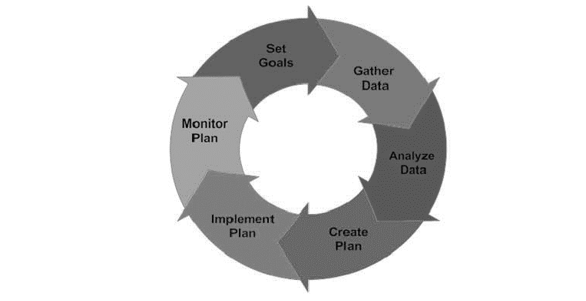
1. Recognizing Need for Action
An important part of the planning process is to be aware of the business opportunities in the firm’s external environment as well as within the firm. Once such opportunities get recognized the managers can recognize the actions that need to be taken to realize them. A realistic look must be taken at the prospect of these new opportunities and SWOT analysis should be done.
Say for example the government plans on promoting cottage industries in semi-urban areas. A firm can look to explore this opportunity.
2. Setting Objectives
This is the second and perhaps the most important step of the planning process. Here we establish the objectives for the whole organization and also individual departments. Organizational objectives provide a general direction, objectives of departments will be more planned and detailed.
Objectives can be long term and short term as well. They indicate the end result the company wishes to achieve. So objectives will percolate down from the managers and will also guide and push the employees in the correct direction.
3. Developing Premises
Planning is always done keeping the future in mind, however, the future is always uncertain. So in the function of management certain assumptions will have to be made. These assumptions are the premises. Such assumptions are made in the form of forecasts, existing plans, past policies, etc.
These planning premises are also of two types – internal and external. External assumptions deal with factors such as political environment, social environment, the advancement of technology, competition, government policies, etc. Internal assumptions deal with policies, availability of resources, quality of management, etc.
These assumptions being made should be uniform across the organization. All managers should be aware of these premises and should agree with them.
4. Identifying Alternatives
The fourth step of the planning process is to identify the alternatives available to the managers. There is no one way to achieve the objectives of the firm, there is a multitude of choices. All of these alternative courses should be identified. There must be options available to the manager.
Maybe he chooses an innovative alternative hoping for more efficient results. If he does not want to experiment, he will stick to the more routine course of action. The problem with this step is not finding the alternatives but narrowing them down to a reasonable amount of choices so all of them can be thoroughly evaluated.
5. Examining Alternate Course of Action
The next step of the planning process is to evaluate and closely examine each of the alternative plans. Every option will go through an examination where all their pros and cons will be weighed. The alternative plans need to be evaluated in light of the organizational objectives.
For example, if it is a financial plan. Then it that case its risk-return evaluation will be done. Detailed calculation and analysis are done to ensure that the plan is capable of achieving the objectives in the best and most efficient manner possible.
6. Selecting the Alternative
Finally, we reach the decision making stage of the planning process. Now the best and most feasible plan will be chosen to be implemented. The ideal plan is the most profitable one with the least amount of negative consequences and is also adaptable to dynamic situations.
The choice is obviously based on scientific analysis and mathematical equations. But a manager’s intuition and experience should also play a big part in this decision. Sometimes a few different aspects of different plans are combined to come up with the one ideal plan.
7. Formulating Supporting Plan
Once you have chosen the plan to be implemented, managers will have to come up with one or more supporting plans. These secondary plans help with the implementation of the main plan. For example, plans to hire more people, train personnel, expand the office etc are supporting plans for the main plan of launching a new product. So, all these secondary plans are in fact part of the main plan.
8. Implementation of the Plan
And finally, we come to the last step of the planning process, implementation of the plan. This is when all the other functions of management come into play and the plan is put into action to achieve the objectives of the organization. The tools required for such implementation involve the types of plans- procedures, policies, budgets, rules, standards etc.
1. Corporate planning
It is planning activities for the entire enterprise. The basic focus is to determine the long-term objectives of the organisation as a whole. And then to generate plans to achieve these objectives taking into consideration the likely changes in the external environment. It is generally carried out at the top level of management. It includes the setting of objectives, organising the work, people and systems to enable those objectives to be attained, motivating through the planning process and through the plans, measuring performance and so controlling progress of the plan and developing people through better decision making, clearer objectives, more involvement and awareness of progress.
The corporate planning activities are carrying out at the top level. They are important for the success of the entire organisation. The top management is responsible for the formulation of such plans and is prepared according to the inputs that are given to them either from the environment or the lower levels in the organisational hierarchy. The plans are generally long term and are broad based.
2. Operational Planning
Operational planning, is also known as tactical or short-term planning, usually, covers one year or so. Operational planning involves the conversion of strategic plans into detailed and specific action plans. These plans are designed to sustain the organisation in its products Operational planning is done at the middle or lower level of management.
Operational planning can be defined as : Operational planning is the process of deciding, the most effective use of the resources already allocated and to develop a control mechanism to assure effective implementation of the actions so that organisational objectives are achieved. Operational planning is concerned with the efficient use of resources already allocated and with the development of a control mechanism to ensure efficient implementation of the action so that business objectives are attained.
3. Functional Planning
The planning that is made to ensure smooth working of the organisation taking into account the needs of each and every department. The purpose of functional planning is to promote standardised management practices for corporate functions in the department’s decentralised corporate management structure.
The following three basic activities have to be carried out in functional planning:
a. Functional Guidance: Managers must be told and guided what they should be doing to properly manage corporate functions within the enterprise.
b. Goal Setting: Certain quantifiable goals need to be set that would measure the effectiveness of the functional planning. Goals should be meaningful, achievable and measurable.
c. Functional Assessments: Functional assessment wraps up the functional planning process. Here the Comparison is made between the goal setting and the goal achievement.
4. Proactive and Reactive Planning
Classification of planning into proactive and reactive is based on the organisation’s response to environmental dynamics. Planning is an open system approach and is affected by environmental factors which keep on changing continuously. However, organisations response to these changes differs. Based on these responses, planning may be either proactive or reactive.
Proactive Planning: It is based on the anticipation of the future outcomes and state of affairs that would affect the working of the organisation. Such a planning has to be broad based, highly flexible and creative by nature. The organisation that favours this kind of planning often anticipates the future and takes necessary steps before the happening of the events. In India, companies like Reliance Industries, Hindustan Lever etc., have adopted this approach and their growth rate has been much faster than others.
Reactive Planning: As the name suggests, this kind of planning is not in the anticipation of the future but becomes active only when the problem is confronted or has already occurred. This is merely the corrective action that is taken. This approach of planning is useful in an environment which is fairly stable over a long period of time.
5. Formal and Informal Planning
Formal Planning exists in the formal hierarchy of the organisation and is always carried out in the stepwise process. It is according to the pre expressed policies and the rules of the organisation. This type of planning is done at a large scale and is based on the logical thinking. The planning process that is adopted is documented, and regular.
Informal Planning is usually carried out in very small organisations where the formal organisation structure may or may not exist. The planning is usually intuitive in nature and is short termed. Since the environment for smaller organisations is not complex, they do reasonably well with informal planning process.
6. Automated planning
Automated planning and scheduling is a branch of artificial intelligence that concerns the realisation of strategies or action sequences, typically for execution by intelligent agents, autonomous robots and unmanned vehicles. This type of planning is normally found in the technologically advanced organisations.
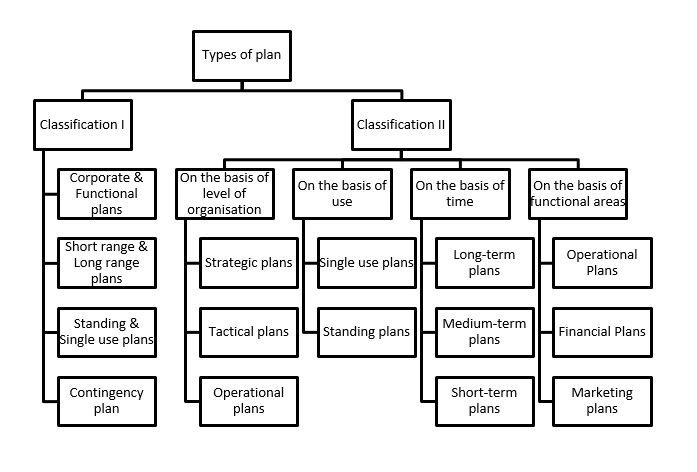
1. Corporate and functional plans
A corporate plan is a roadmap that lays out the business plan. It examines a business’s internal capabilities and lays out strategies for how to use those capabilities to improve the company and meet goals.
A functional plan describes how, when and where the objectives and goals will be accomplished for each function as well as for the entire business.
2. Short-range and long-range plans
Short-range plans generally apply to a specific time frame in which a specific series of operations will be carried out, assessed, and measured. The standard short-range plan will represent annual or semi-annual operations with a short-term deliverable. These short-term plans cover the specifics of each day-to-day operation.
Long-range plans are arguably the most crucial to the continued success of a business, ultimately highlighting the way in which operations interact to achieve long-term profitability and returns on investment. As corporations grow in size and complexity, so the long-range plans that constitute the interaction of individual processes. Long-range plans are those most closely related to the overall strategic-planning process.
3. Standing and single use plans
Standing plans are formulated once and repeatedly used. They continuously guide managers; thus, they are a standing guide to solving problems. The most common standing plans are:
a. Mission or purpose: It identifies the basic task of an organisation for which it is created.
b. Strategy: It determines the basic long-term objectives of an enterprise and adoption of courses of action and allocation of resources necessary to achieve these objectives.
c. Policies: It provides guideline for repetitive actions. They define an area or provide limits within which decisions are to be made and ensure that the decision will be consistent with and contribute to an objective. They allow decision makers some discretion to carry out a plan. It permits managers to delegate authority and still maintain control about subordinates about the matter.
d. Rules: Rules like policies, are standing plans that guide action. They spell out specifically what employees are supposed to do or not to do. As opposed to policies, rules do not permit the exercise of individual discretion. Rules specify what actions will be taken (or not taken) and what behaviour is permitted or not.
e. Procedures: They provide guidelines for action rather than speculation. They are plans that establish a required method of handling future activities. They establish customary ways for handling certain activities. It represents a chronological sequencing of events. It specifies a series of steps that must be taken to accomplish a task.
Single use plans are prepared for single or unique situations or problems and are normally discarded or replaced after one use. Generally, there are four types of single use plans:
4. Contingency plan
These plans are made to deal with situation that might crop up if these assumptions turn out to be wrong. These are alternate courses of action to be taken if events disrupt a planned course of action. Such plans allow management act immediately if unforeseen events as strikes, boycotts, natural disaster or major economic changes render existing plans inoperable or unsuitable.
1. On the basis of level of organisation
a. Strategic plans: An outline of steps designed with the goals of the entire organisation as a whole in mind, rather than the goals of specific divisions or department. They look ahead over the next two, three, five or even more years to move the organisation from where it currently is to where it wants to be. They demand harmony among all the levels of organisation.
b. Tactical plans: They are concerned with what lower level units within each division must do, how they must do it, and who is in charge at each level. Tactical plans are concerned with shorter time frames and narrower scopes than strategic plans. They usually span one year or less.
c. Operational plans: Managers use these plans to accomplish his/her job responsibilities. Supervisors, team leaders and facilitators develop operational plans to support tactical plans. They determine how specific tasks can best be accomplished on time with available resources. They cover day-to-day operations of an organisations.
2. On the basis of use
a. Single use plans
b. Standing plans
3. On the basis of time
a. Long-term plan: It is the long-term process that business owners use to reach their business mission and vision. It determines the path for business owners to reach their goals. It reinforces and makes corrections to the goals as the plan progresses.
b. Intermediate-plan: It covers six months to two years. It outlines how the strategic plan will be pursued.
c. Short-term plan: Plans for a few weeks or at most a year. It allocates resources for a day to day business development within the strategic plan. These plans outline the objectives necessary to meet intermediate plans and the strategic planning process.
4. On the basis of functional areas
a. Operational plans: Managers use these plans to accomplish his/her job responsibilities. Supervisors, team leaders and facilitators develop operational plans to support tactical plans. They determine how specific tasks can best be accomplished on time with available resources. They cover day-to-day operations of an organisations.
b. Financial plans: The three primary financial statements (balance sheet. Income statement and cash flow statement) created within a business plan. It is the annual projection of income and expenses of the company, division or department. It can also be an estimation of cash needs and a decision on how to raise cash.
c. Marketing plans: It outlines the marketing strategy for the coming year, quarter or month. It includes the business’s marketing and advertising goals, a description of the business’s current marketing position, target market and customer needs.