
Learning is a continuous process. It occurs all the time. Learning is any relatively permanent change in behaviour that occurs as a result of experience. We can say that the changes in the behaviour indicate that learning has taken place and that learning is a change in behaviour.
The definition of learning highlights the following characteristics of learning:
There are four steps for the learning to take place (Fig.):
Step-1-Input: There should be a stimulus which is clearer to the learner. In work settings, unless the employee understands the messages communicated by the management, he is unlikely to be affected in the appropriate direction as intended by the communication.
Step-2-Response: Response means the act which the learner has to perform. He should be allowed and encouraged to practice the performance response.
Step-3-Motivation: There must be a motivation or drive before there can be any learning. Motivation involves interest & the attitude to learn, he is likely to learn even though he possesses adequate capacity to learn and understand what is being taught.
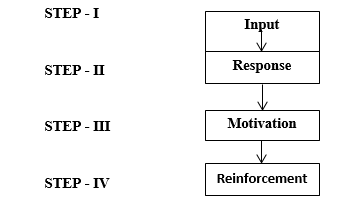
Fig. Step in learning process
Step-4 Reinforcement: Reward or incentive refers to what satisfies a motive. If the person is not rewarded or does not perceive the likelihood of the reward in near future, he stops learning and even tends to unlearn the skills which he already possesses.
These steps in learning have a direct bearing on training in organisational settings.
Training can be effective if these steps are adhered to. Management often takes into account only stimulus and response but ignores the actual motivation of the trainee and requirement for giving a feeling of adequate forthcoming reward.
Four theories have been offered to explain the process by which we acquire pattern of behaviour. These theories are:
1. Classical Conditioning: It is a type of conditioning where an individual responds to some stimulus that would not invariably produce such a response. Classical conditioning grew out of experiments to teach dogs to salivate in response to ringing of the bell, conducted by Russian psychologist, Ivan Pavlov.
A simple surgical procedure allowed Povlov to measure accurately the amount of saliva secreted by a dog. When Povlov presented the dog with a piece of meat, the dog exhibited a noticeable increase in salivation. When Pavlov withheld the presentation of meat and nearly rang a bell, the dog has no salivation. Then Pavlov proceeded to link the meat and the ringing of the bell. After repeatedly hearing the bell before getting the food, the dog began to salivate nearly at the sound of the bell even if no food was offered. In effect, the dog learned to respond, that is to salivate to the bell.
The meat was an unconditioned stimulus. It invariably caused the dog to react in a specific way. The reaction, that took place whenever the unconditioned stimulus occurred, was called as unconditioned response. The bell was the artificial stimulus or conditioned stimulus. While it was originally neutral when the bell was paired with the meat (an unconditioned stimulus), it eventually produced a response when presented alone. It is the conditioned response. This describes the behaviour of the dog salivating in reaction to the bell alone (Fig. given below).
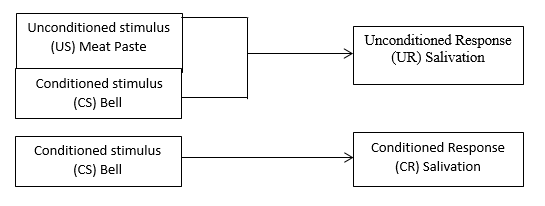
Fig. Pavlov Experiment
Using these concepts, we can summarize the classical conditioning. Learning a conditioned response involve building up an association between conditioned stimulus and an unconditioned stimulus. Using the paired stimuli, one compelling and other one neutral, the neutral one becomes a conditioned stimulus and hence takes on the properties of the unconditioned stimulus (Fig. given below).
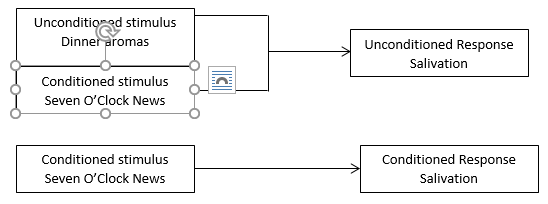
Fig. Pavlov Experiment
Classical conditioning is passive. Something happens and we behave in a specific way. It is elicited in response to a specific, identifiable event. As such, it can explain simple reflexive behaviours. But most behaviour, particularly the complex behaviour of individuals in organisation, is emitted rather than elicited. It is voluntary rather than reflexive. For example, employees choose to arrive at work on time, ask their superior for help with problems. The learning of these behaviours is better understood by looking at operant conditioning.
2. Operant Conditioning: Operant is defined as behaviour that produces effects. Operant conditioning given by Skinner suggests that individuals emit responses that are rewarded and will not emit responses that are either not rewarded or not punished. Operant conditioning is a voluntary behaviour and it is determined, maintained and controlled by its consequences. In contrast, respondent behaviour is an involuntary response to an environmental stimulus.
Operant conditioning acts on environment to produce consequences. It is basically assumed that man’s behaviour is determined by environment and individuals learn by producing alteration in their environment. Operant conditioning presupposes that human beings explore their environment and act upon it. In classical conditioning the sequence of event is independent of subject’s behaviour. In operant conditioning, reinforcement is given only when the correct response is made. According to Skinner, the consequences determine the likelihood that the given operant will be performed in the future. To change behaviour, the consequences of that behaviour must be changed (Fig. given below).
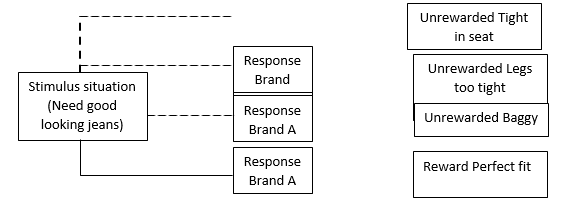
Fig. A model of operant conditioning
Operant conditioning is a powerful tool for managing people in organisations. Most behaviours in organisations are learned, controlled and altered by the consequences, i.e. operant behaviours.
Management can use the operant conditioning process successfully to control and influence the behaviour of the employees by manipulating its reward system. If one expects to influence behaviour, he must also be able to manipulate the consequences.
Four types of reinforcement strategies can be employed by managers to influence the behaviour of the employees:
1. Positive Reinforcement: It strengthens and increases behaviour by the presentation of the desirable consequence (reward). Positive reinforcer is a reward that follows behaviour and is capable of increasing the frequency of the behaviour. Effective reinforcer must meet the two conditions:
a. The reward should be contingent upon the rate of performance.
b. The reward should be matched with the need or the desire of the performer.
There are two types of positive reinforcer :
a. Primary reinforcers.
b. Secondary reinforcers
c. Primary reinforcers such as food, water and sex are of biological importance in that they are innately satisfying and have effects which are independent of past experiences. Primary enforcers must be learned.
d. Secondary reinforcers such as job advancement, recognition, praise and esteem result from previous association with a primary reinforcer.
e. In order to apply reinforcement procedure successfully, management must select reinforcers that are sufficiently powerful and durable.
2. Negative Reinforcement: The threat to punish rather than to give reward is called as negative reinforcement. Negative reinforcers also serve to strengthen desired behaviour responses leading to their removal or termination. Negative reinforcement is employed to increase the frequency of a response by removing a noxious consequence. People learn a negatively reinforced behaviour through an avoidance learning process. Skinner approach is primarily based on the principles of the positive reinforcement only.
3. Extinction: It is an effective method of controlling undesirable behaviour. It refers to non-reinforcement. It is based on the principle that if the response is not reinforced, it will eventually disappear. For example, a teacher ignores a noisy student, the student may drop the attention getting behaviour. Extinction is less painful than punishment because it does not involve the direct application of an aversive consequence. Students who perform well are praised quite often by the teachers. If they begin to slack off and turn out poor performance, the teacher may try to modify their behaviour by withholding praise. Extinction is a behavioural strategy that does not promote desirable behaviours but can reduce undesirable behaviours. If the students eventually show the good work, the teacher may again praise them (positive reinforcement) but if the poor performance is again resulting in, extinction will be re-employed.
4. Punishment: It is a control device employed in the organisations to discourage and reduce annoying behaviours. It can take either of the two form:
a. These can be withdrawal or termination of a desirable or rewarding consequence.
b. There can be an unpleasant consequence after a behaviour is performed.
Punishment reduces the response frequency; it weakens behaviour. The use of abrasive control is the most controversial method of modifying behaviour because it produces undesirable by-products.
Instrumental learning theorists believe that learning occurs through a trial and error process, with habits formed as a result of repeated rewards received for certain responses or behaviours. This model of learning applies to many situations in which consumers learn about products, services and retailers.
Critics of instrumental learning theory point out that a considerable amount of learning takes place in the absence of direct reinforcement, either positive or negative. We do not have to be arrested to know that we would obey the law. Individuals learn a great deal through a process, psychologists call modelling or observational learning (vicarious learning). They observe the behaviour of others, remember it and imitate it. Instrumental theorists argue that children learn in this way because they can envision a reward, and, therefore, imitate the behaviour that leads to it. But critics maintain that instrumentalists confuse learning and performance (behaviour). Both children and adults learn a great deal that they do not act upon. Moreover, they may learn merely for the sake of learning, not for the sake of rewards. The belief that learning is a function of thinking, of mental processes, is known as cognitive theory.
Cognitive Theory: The theory was given by He held that learning involves a relationship between cognitive environmental cues and expectations. He evolved and tested this theory through controlled experiments using rats in the laboratory. He showed that rats learned to run through a complicated maze towards a goal (food). It was observed that rate developed expectations at every choice point in the maze. Thus, they learned to expect that certain cognitive cues related to the choice point could ultimately lead to food. In situations where rats got the food, the relationship between the cues and expectancy was strengthened and learning look place. Tolman approach is also called as stimulus-stimulus approach. These experiments embarrassed the behaviouristic learning theorists. Reinforcement failed to predict rats’ behaviour and it was no longer a pre-requisite to learning. One stimulus led to another stimulus rather than classical S-R or operant R-S interpretation. Indeed, the rats’ behaviour was purposive. In other words, they learned a cognitive map to determine how to reach food.
Tolman made significant contributions to learning theory by forcing the behaviouristic theorists to evolve highly complex explanation of behaviour and indicating the need to include cognitions in a mediating role between the environmental stimulus and the behaviour. These theories exerted a strong effect on early human relations movement.
Social Learning Theory: Individuals can also learn by observing what happens to other people and just by being told about something as well as by direct experiences. For example, what we learn comes from watching models i.e., from our parents, teachers, peers, superiors and so forth.
While social learning theory is an extension of operant conditioning, that is, it assumes that behaviour is a function of consequences. It also acknowledges the existence observational learning and the importance of perception in learning. People respond to how they perceive and define consequences, not to the objective consequences themselves.
The influence of models is central to the social learning viewpoint. Four processes have been found to determine the influence that a model will have on an individual. These are :
1. Attentional Processes: People only learn from a model when they recognize and pay attention to its critical features. We tend to be most influenced by models that are attractive, repeatedly available and we think are important or we see as similar to us.
2. Retention Processes: A model’s influence will depend on how well the individual remembers the model’s action, even after the model is no longer readily available.
3. Motor Reproduction Processes: After a person has seen a new behaviour by observing the model, the watching must be converted to doing. This process then demonstrates that the individual can perform the modelled activities.
4. Reinforcement Processes: Individuals will be motivated to exhibit the modelled behaviour, if positive incentives or records are provided. Behaviours, that are reinforced, will be given more attention, learned better and performed more often.
Behaviour Modification :
Learning is essential for human resource development. Technical skills, motivational values and behavioural conduct are developed through the learning process. Organisational behaviour is instrumental in increasing productivity and effectiveness. Reflexive behaviour, operant behaviour and social learning behaviour are developed for the modification of organisational behaviour. Technically speaking, modification of organisational behaviour involves identification, measurement, analysis, intervention and evaluation behaviour.
“Behaviour modification is a programme where managers identify performance related employee behaviour and then implement an intervention strategy to strengthen desirable behaviours and weaken undesirable behaviours.” -P. Robbins
The extension of behaviour modification into organisation is called organisational behaviour modification or OB Mod. Principles of reinforcement theory are applied to human resource: management problems to change and direct organisational behaviour towards the attainment of organisational and societal objectives. OB mod is not a theory of work motivation. Instead, it is a technique for motivating employees using principles of reinforcement theory. OB mod focuses on an observable and measurable behaviours instead of needs, attitudes or internal states.
A typical behaviour modification program involves a five step problem solving model (fig. given below)
STEP-I-Identification of performance related behaviours: As the first step, the behaviours (critical) which have significant impact on the performance outcome of the employees should be identified. Employees may be engaged in several behaviours in the organisation. Out of these, some behaviours may be critical like absenteeism or attendance, tardiness or constructive criticism and doing or not doing a particular task or procedure and some behaviours may not be critical like bad attitudes or goofing off. Critical behaviours may be identified through the discussion with the particular employee and his immediate superior as both are closely intimated with the job behaviours. A systematic behaviour audit can also be carried as to identify such behaviour. The audit would systematically analyse each job in question on the pattern of job analysis.
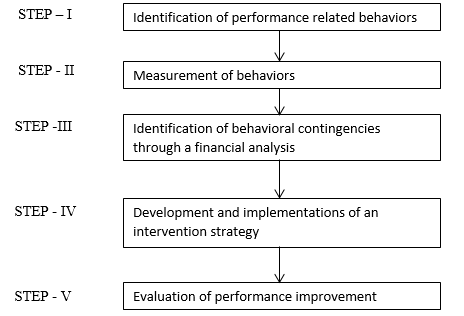
Fig. Behaviour modification procedure
STEP-II-Measurement of behaviours: In the process of measurement of behaviours a manager develop some base line performance data. The manager records the frequency of the critical behaviour over time. This allows the manager to determine his success in changing the subordinates, behaviour. It may also provide insight into the circumstances associated with each critical behaviour.
STEP-III-Identification of behavioural contingencies through a functional analysis: A functional analysis refers to an examination of the antecedents consists of environmental conditions surrounding the behaviour and any action that occurred immediately prior to the behaviour. The consequences consists of all the outcomes associated with the behaviour, both positive and negative. Since human behaviour is so complex, identifying all the antecedents and consequences is extremely difficult.
STEP-IV-Development and implementation of an intervention strategy: Identification of critical behaviours to change and the factors that cause such behaviours will determine the development of an appropriate intervention strategy Intervention is the action taken for changing the undesirable critical behaviours. Its main objective is to strengthen and accelerate desirable performance behaviour or weaken undesirable behaviours. There may be many intervention strategies that can be used, but the main strategies are based on the principles of reinforcement i.e., positive reinforcement, negative reinforcement, and withdrawal of positive reinforcement. The strategies selected must be appropriate to the situation and should produce the desired result.
STEP-V-Evaluation of performance improvement: The learning process of modification of behaviour must be evaluated for making a positive impact. The learning process is used for modification, so the learning behaviour and results are appraised for achieving long-lasting effects. Evaluation will help in the termination of negative performance and behaviour and accelerate positive behaviour. Systematic evaluation of behaviour helps in modification and improvement for achieving favourable behaviour & performance. It involves, reaction learning, change and improvement of behaviour. Reactions of employees are noted as cues for the direction and behaviour modification. Positive reactions help easy and correct behaviour. Negative reactions are viewed as discontentment, which is to be explored and remedied. The learning process helps implement changes in behaviour. Modified behaviour will give a positive response and performance.
Modification of behaviour lays emphasis on self-management. Employees are motivated to manage their own behaviour. They are given positive reinforcement and a favourable atmosphere to pay attention to positive stimuli, internal processes and responses to achieve a favourable response. They are given opportunities for self-learning, self-monitoring and adopting favourable behaviour. Incentives to self-learning help self-modification. Responsibility oriented employees are accustomed to self-learning and self-modification.