
The hospital organization is a peculiar organization in the sense as:
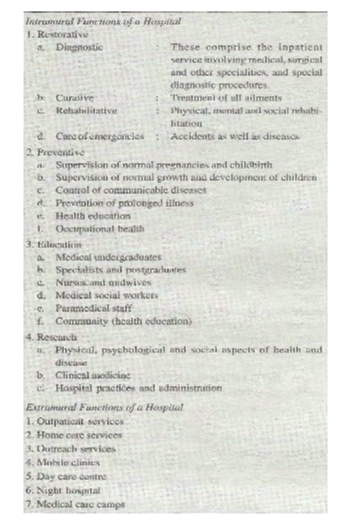
The hospitals have following different roles in the society:
The basic responsibility of the hospital is to provide immediate care to the sick and injured and the first requirement is to provide accommodation in the hospital depending upon.
The patient needs to be admitted, based upon principles of progressive patient care in the wards, right patient on the right bed with right services available to him. The patients are given accommodation according to the severity of illness and need. The hospital should be able to provide proper diagnostic, therapeutic, support and utility services.
The hospital is a social and medical organization and has to provide primary care to the community as relevant. The hospitals play a very important role in promotion of health and prevention of diseases. The hospitals are involved in various activities like immunization, MCH and family planning, health education of patients and their relatives, establishment of well baby clinics, counseling sessions, provision of audio-visual aids for health promotion. The most important role of hospital in provision of primary health care is through the outreach programs. The consultants visit to primary care and secondary care hospitals based upon the philosophy of reaching to the people in their home environment. The hospitals provide referral services to the primary care hospitals.
The surveillance means data collection for action. To keep a strict watch with great authority over the factors which are responsible for causation and spread of the disease. All those cases which are missed by the routine surveillance go to the hospitals and the hospitals can act as sentinel surveillance centres for detection, recording and reporting of such cases to the public health authorities.
Regular follow up measures are taken by the hospitals for regular care of the patients.
Hospitals provide rehabilitation services through development of physiotherapy and occupational therapy units.
The hospitals provide support system for education and training of its staff. In addition to the award of degrees, diplomas and certificate courses, the hospitals also provide continuing medical education (CME) to the medical, nursing and para medical staff.
Research is carried out on the physical, psychological and social aspects of the health and disease. Big clinical trials on drugs and methods of treatment can not be conducted without the active support and involvement of the hospital.
The treatment provided by hospitals in India is at par with developed countries but at the same time the treatment cost is much less and which has shown encouraging results for foreigners to visit India for availing treatment. The foreigners come to India as tourist, visit many places of their choice and also undergo treatment in some of the good hospitals. The combined cost of availing treatment and tourism is much less than the cost of treatment incurred in developed countries. The hospitals have to develop on the lines of five star hotels for providing amenities to patients and visitors. The hospitals will have to tie up with travel and tourism industries to attract more foreigners for availing treatment in India.
There is an increasing role of hospitals in partial or complete contracting with other agencies. The contracting may be in raising and commissioning of the hospitals, financing of the institutions, supply chain management, staffing of the hospitals, installation of equipments, rendering of sanitary services; housekeeping services, security services or management of the organization. The hospitals have to keep updated in legal aspects of contracting.
The hospitals particularly the corporate hospitals have to work on the lines of industry. If it is to be viable, it has to be productive.
The hospitals have to provide great support in the field of telemedicine and with the advancement of information technology and computers and robotics. This role will further expand in times of come.