
Motivation is an important function which every manager performs for enthusing people to work for the accomplishment of organisational objectives. Issuance of well conceived instructions and orders does not mean that they will be executed. A manager has to make appropriate use of motivation to enthuse the employees to get their instructions executed. Effective motivation succeeds not only in having an order accepted but also in gaining a determination to see that it is executed efficiently and effectively.
The term ‘motivation’ has been derived from the word ‘motive’ which means anything that initiates or sustains activity. It is an inner state that energises, activates or moves and that directs or channelise behaviour towards goals. Motive is a psychological force within an individual that sets him in motion for the achievement of certain goals or satisfaction of certain needs.
According to Likert, “Motivation is the core of management.”¹ By motivating the work-force, management creates ‘will to work’ which is necessary for the achievement of organisational goals. Motivation involves getting the members of the group to pull weight effectively, to give their loyalty to the group, to carry out properly the tasks assigned and to play an effective role in contributing towards the purpose the organisation has undertaken. If the members of an organisation are properly motivated, the following results may be expected :
Thus, it is obvious that motivation is the core of management. It is a basic duty of every manager to motivate his subordinates or to create the ‘will to work’ among the subordinates. It should also be remembered that a worker may be immensely capable of doing some work, but nothing can be achieved if he is not willing to work. Creation of will to work is motivation in simple but true sense of the term.
“Motivation is something that moves a person to action, and continues him in the course of action already initiated.” Motivation refers to the way a person is enthused at work to intensify his desire and willingness to use his potentialities for the achievement of organisational objectives. It is something that moves a person action and continues him in the course of action enthusiastically. The role of motivation is to develop and intensify the desire in every member of the organisation to work effectively and efficiently in his position.
“Motivation refers to the way in which urges, drives, desires, aspirations, strivings or needs direct, control or explain the behaviour of human beings.”
-Dalton E. McFarland
“Motivation in the complex set of forces starting and keeping a person at work is an organisation.
-Robert Dubin
“Motivation represents an unsatisfied need which creates a state of tension or disequilibrium, causing the individual to march in a goal-directed pattern, towards restoring a state of equilibrium by satisfying the need.
-Stanley Vance
Need is the starting point of motivation. However, any need in the individual does not necessarily lead to action The need has to be activated which is the function of incentive. Incentive is something which incites or tends to incite towards some determination. Thus, incentive is an external stimulus that. Activates need and motive refers to an activated need, an active desire or wish. When a motive is present in a person it becomes active when there is some incentive. Thus, any incentive refers to :
The conceptual difference between motivation and incentive is that incentive is the means to motivation. It has been found that incentive has a direct bearing on the degree of motivation. Increase in incentive leads to better performance and decrease in incentive leads to poor performance. It should be noted that motivation does not change the individual’s capacity to work. It simply determines the level of effort of an individual and neither raises it nor lowers it. Keith Davis says that motives are expression of a person’s needs; hence they are personal and internal. Incentives, on the other hand, are external to the person. They are something he perceives in his environment as helpful towards accomplishing his goal. For instance, management offers salesmen a bonus as an incentive to channel in a productive way their drives for recognition and status.
The unsatisfied need of a person is the starting point in the motivation process as shown in given fig. The unsatisfied need results tension within the individual and motivates him to search for the ways to relieve this tension. He develops certain goals for himself. If he is successful in achieving his goals, some other needs will emerge which will lead to setting a new goal. But if the goal is not achieved, the individual will engage himself in either constructive or destructive behaviour. This process never stops. It continues within an individual
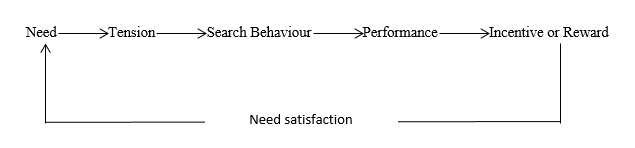
Fig. Needs and Motivation.
Sometimes, a person is not able to satisfy his needs despite repeated attempts. His failure might lead to frustration. A frustrated worker may behave in one or more of the following ways:
Three categories of theories have evolved over the years which tend to complement each other. These are briefly discussed below :
The conscious application of operant conditioning is called OB Mod, i.e., Organisational Behaviour Modification Under this, managers can focus on positive reinforces as rewards that influence behaviour and strengthen the future probabilities of desirable behaviour.
One of the first behavioural scientists to make management aware of the complexity of human needs and their effect on motivation was Abraham Maslow. When formulating his theory of motivation during the 1940s, Maslow acknowledged that people really have many needs. Maslow felt that mankind’s diverse needs could be condensed within the following five basic categories:
Maslow’s theory holds that these needs are arranged in a prepotent hierarchy, as illustrated in given Fig.
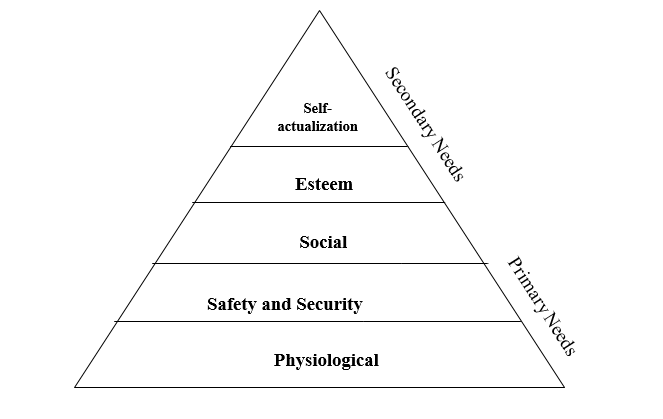
Fig. Maslow’s Need Hierarchy
The need hierarchy implies that lower level needs require satisfaction and thereby affect behaviour before higher level needs have an effect on motivation. That is, according to Maslow, an individual will be motivated to satisfy the need that is prepotent, or most powerful for him or her, at a specific time. Before the next level need becomes the most powerful determinant of behaviour, the lower-level need must first be satisfied. “When the needs that have the greatest potency and priority are satisfied, the next needs in the hierarchy emerge and press for satisfaction. When these needs are satisfied, another step up the ladder of motives is taken.”
Although Maslow’s theory of human needs seemed to provide managers with a useful description of the motivation process, subsequent empirical studies have not totally substantiated it. Whereas people can be classified within broad categories of higher and lower-level needs, a strict five-category hierarchy does not seem to exist. Nor has the concept of a prepotent hierarchy been totally supported. Gratification of one need does not automatically activate the next level need as a motivator of performance.
The proposition that one need is satisfied at one time is also of doubtful validity. The phenomenon of multiple motivation is of great practical importance in understanding the behaviour of man. Man’s behaviour at any time is mostly guided by multiplicity of motives. However, one or two motives in any situation may be prepotent, while others may be of secondary importance. Moreover, at different levels of needs, the motivation will be different. Money can act as a motivator only for physiological and social needs, not for satisfying higher level needs.
Another major criticism of Maslow’s theory is that it failed to take individual differences into account. Edward Lawler presents, in contrast, an individual’s expectancy (effort-performance probability) that is learned from past experience. Thus, because of past experience, self-actualisation may be a dominant need for one person, but another ostensibly similar person working in a similar capacity (might have suffered during economic depression, for example), continue to manifest motivation by safety needs even though both have attained considerable financial security.
To sum up, the managers must be aware of individual differences in reward preferences. What will motivate one subordinate will not work with another individual. Different people want different things, and managers must be sensitive to these needs if they want to motivate their subordinates.
The proposition that one need is satisfied at one time is of doubtful validity. The phenomenon of multiple motivation is of great practical importance in understanding the behaviour of man. Man’s behaviour at any time is mostly guided by multiplicity of motives. However, one or two motives in any situation may be prepotent, while others may be of secondary importance. Moreover, at different levels of needs, the motivation will be different. Money can act as a motivator only for physiological and social needs, not for satisfying higher level needs.
Another motivational model stressing higher-level needs is that of David McClelland who described people in terms of three needs: power, achievement, and affiliation. These are discussed on the next page.
McClelland’s theory and research have significant implications for managers. The motives of employees can be accurately measured, management can improve the selection and placement processes. For example, an employee with a high need for achievement may be placed in a position that would enable him to achieve. This would result in higher performance. Need for achievement (n Ach) is the most crucial to a nation’s economic progress as it contributes to entrepreneurial success.
Achievement motivated people can be the backbone of the organisation. Managers should raise the achievement need level of subordinates by creating a proper work environment.
Achievement motivation model, however, suffers from the following limitations :
Despite these limitations, McClelland’s theory is a useful contribution for work motivation.
During the late 1950s Frederick Herzberg and his associates developed another need-based model of motivation. Herzberg’s research team asked 200 engineers and accountants, of a large paint company to respond to the questions: “Can you describe, in detail, when you felt exceptionally good about your job?” and “Can you describe, in detail, when you felt exceptionally bad about your job?”
Herzberg found that the responses could be grouped within two general categories, which he called hygiene factors and motivators. These are listed in Exhibit given below.
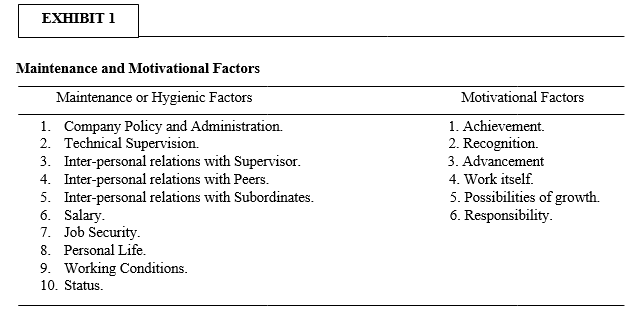
Hygienic factors include wages, fringe benefits, physical conditions and overall company policies, administration, etc. The presence of these factors at a satisfactory level prevents job dissatisfaction, but does not provide motivation to the employees. So they are considered as hygiene or maintenance factors. Motivational factors, on the other hand, are essential for increasing the productivity of the employees. They are also known as satisfiers and include such factors as recognition, feeling of accomplishment and achievement, opportunity of advancement and potential for personal growth, responsibility and sense of job and individual importance, new experience and challenging work, etc.
The hygiene factors are primarily related to the environment in which work is performed whereas the motivators are primarily related to the nature of the work itself. According to Herzberg, the hygiene factors result in dissatisfaction if they are not present or are inadequate. If they are adequate, they do not induce motivation or give satisfaction. In contrast, if the motivators are absent or inadequate, they do not result in dissatisfaction. If adequate, however, the motivators are the factors responsible for motivating workers and assuring job satisfaction.
Attacking Herzberg’s two-factor theory, Vroom offered an expectancy approach to the understanding of motivation. According to him, a person’s motivation towards an action at any time would be determined by his anticipated values of all the outcomes of the action multiplied by the strength of that person’s expectancy that the outcome would yield the desired goal. In other words, motivation is a product of the anticipated worth to a person of an action and the perceived probability that the person’s goals would be achieved.
Motivational Force (M) = Expectancy (E) x Instrumentality (I) x Valence (V)
Or M = (E x I x V)
There are three elements of this model which are discussed as under :
1. Expectancy (Effort-Reward Probability). This is a person’s perception or outcome of an action. The likelihood is probabilistic in nature and describes that relationship between an act and an outcome. For example, if a student. Works hard, he expects to do well in the final examination. The value of expectancy ranges from 0 to + 1. If the individual feels that chances of achieving an outcome are zero, he will not even try. On the other hand, if expectancy is higher, the individual will put higher efforts to achieve the desired outcome.
2. Instrumentality (Performance-Reward Probability). This factor relates to a person’s belief and expectation that his performance will lead to a particular outcome or reward. It is the degree of association of first level outcome of a particular effort to the second level outcome, which is the ultimate reward. For example, working hard may lead to better results, which is first level outcome, which may result in a reward like raise in pay or promotion or both which is the second level outcome. If a person believes that his high performance will not lead to expected rewards, he will not be motivated to work hard for better output. The value of instrumentality also ranges from 0 to 1 as it is with the probability of achieving the desired outcome or goal.

3. Valence (Reward Preference). It is the value a person assigns to the desired reward. He may not be willing to work hard to improve performance if the reward of such improved performance is not what he desires. It is not the actual value of the reward, but the perceptual value of the reward in the mind of the worker that is important. A person may be motivated to work hard, not to get pay raise, but to get recognition and status. Another person may be more interested in job security than with status.
People have different valence for various outcomes. The relative valence they attach to various outcomes is influenced by conditions such as age, education and type of work. The valence of a person for a goal may be positive or negative depending upon his positive or negative preference for this goal If a person is indifferent to an outcome, his valence is zero. Thus, the total range of valence is from -1 to +1.
According to Vroom’s model, the person’s level of effort (motivation) depends upon :
a. The worker must be confident that his efforts will result in greater productivity and that he has the ability to perform the task well.
b. The worker must be confident that such high performance will be instrumental in getting the desired rewards.
c. The worker must value these rewards as desired and satisfactory.
Motivation is related to all these three factors. As the relationship suggests, the motivational force will be higher when expectancy, instrumentality and valence are all high. The management must recognize and determine the situation as it exists and take steps to improve upon these factors for behavioural modification so that these three elements achieve the highest value individually.
A worker may exhibit a poor behaviour due to:
This model is an improvement over the Valence-Expectancy model. Porter and Lawler applied their model to study the behaviour of managers and concluded that there exists a complex relationship between job attitudes and job performance. This model encounters some of the simplistic traditional assumptions about the positive relationship between satisfaction and performance. “The emphasis in expectancy theory on rationality and expectations seems to us to describe best the kinds of cognition that influence managerial performance. We assume that managers operate on the basis of some sort of expectancies which although based upon previous experience are forward oriented in a way that does not seem to be as easily handled by the concept of habit strength.”
The various elements of Porter and Lawler’s model as depicted in given Fig :
Effort. It refers to the amount of energy exerted by a person on a job.
Perceived-effort-reward probability. It refers to the individual’s perception of the probability that different rewards depend upon different degrees of efforts. Value of reward and perception of effort-reward probability will determine the amount of efforts a person will put.
Performance. Effort leads to performance. But both may not be equal In fact, performance is determined by the amount of effort and ability and role perception of the individual. That means, if an individual is lacking in ability and/or has wrong role perception, his performance is bound to be unsatisfactory in spite of his putting great efforts.
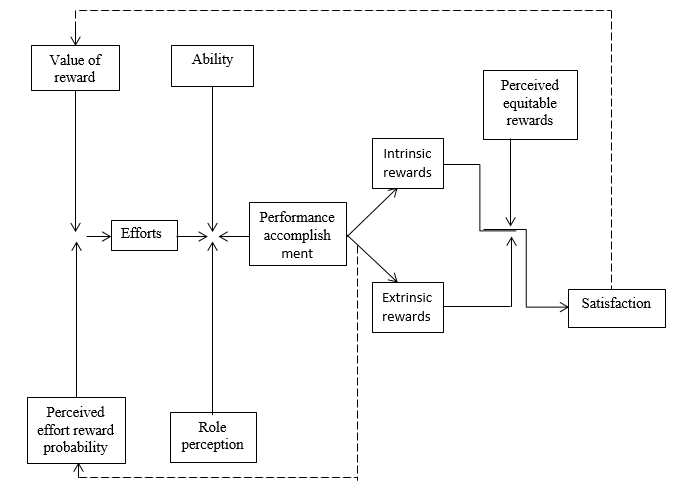
Fig. Porter and Lawler’s Motivation Model.
Rewards. Performance may lead to two kinds of rewards, namely, intrinsic rewards such as a sense of self-actualisation and extrinsic rewards such as working conditions and status. The intrinsic rewards are much more likely to produce attitudes about satisfaction that are related to performance. Moreover, the perceived equitable rewards vitally affect the performance-satisfaction relationship. They reflect the fair level of rewards that the individual feels should be given for a particular level of performance.
Satisfaction. The extent to which actual rewards fall short, meet or exceed the individual’s perceived level of equitable rewards determines the degree of satisfaction. If actual rewards meet or exceed perceived equitable rewards, the individual will feel satisfied and if these are less than equitable rewards, the individual will feel dissatisfied.
Thus, satisfaction is only in part determined by actual rewards and that satisfaction is more dependent on performance than performance is on satisfaction. Only through the less direct feedback loops, satisfaction will affect performance. Porter and Lawler’s framework is, thus, a marked departure from the traditional analysis of satisfaction and performance relationship. In practice, we see that motivation is not a simple cause and effect relationship, rather is a complex phenomenon. Porter and Lawler suggested that managers should carefully assess their reward structure and that through careful planning and careful definition of role requirements, the effort-performance reward satisfaction systems should be integrated into the overall system of managing.
Role of Managers. The managers should take the following steps to motivate the workers:
Equity Theory of motivation was formulated by J.S. Adams. It is based on the assumption that members of an organisation experience strong expectations of justice, balance and fairness in treatment by their employers.14 In equity theory, two variables are important, i.e., inputs and outcomes. Inputs are the qualities and elements which a member of an organisation perceives that he puts into his job. Outcomes are the things which the member receives from the organisation and his job. Inputs and outcomes are important elements in the exchange relationship between the organisation and its members. When the individual finds equity in the situation or feels that what he receives from the organisation in terms of treatment and compensation is fair in terms of effort and skills, he contributes to the organisation, he is satisfied with the arrangement, and is normally committed to the organisation and its goals.
Equity = Person’s outcomes = Others’ outcomes
Person’s inputs Other’s inputs
The main postulates of the equity theory are as follows:
Equity theory is one of the most rigorously developed theories of social exchange relationships. It provides useful guidance to managers in several ways. First, it tells managers that equity motive is one of the important motives of employees. Secondly, while determining a wage structure in the organisation, managers must pay attention to equity considerations. Thirdly, perception in work settings is as important as facts in motivating people at work.
Equity theory has the following limitations:
Financial incentives are very commonly used in modern organisations to motivate the employees to increase their productivity. These include wages and salaries, bonus, insurance, medical allowance, housing facilities, and retirement benefits. They are paid in terms of money. It is generally said that higher these benefits, higher is the productivity of workers. But this is not always so. Monetary benefits have only limited utility in increasing the motivation of employees. After the basic needs have been met, the role of money in motivating the employees is generally decreased. The management has to make use of non-financial incentives also to motivate the employees.
Money plays an important role in motivation of employees. Managements generally make use of financial incentives to motivate the workers. However, such incentives may not always prove to be motivating. In many cases, management may have to increase the financial incentives to keep the workers with the organisation. This can be appreciated from the practice of making wages and salaries competitive between various enterprises. Money is a real motivating factor when the psychological (food, clothing and shelter) needs of the workers have not been satisfied. Money helps in satisfying the social needs of the workers to some extent because money is often recognised as a basis of status, respect, and power. Money is also an important means of achieving a ‘minimum’ standard of living although this ‘minimum’ has the tendency to go up as people become more affluent. But it can’t be concluded that money loses its importance after a certain stage.
To some people, non-financial rewards are more important. They are motivated by money upto the stage they are struggling for physiological and security needs. People in higher positions, who get higher monetary rewards, are not motivated by monetary benefits. They may be motivated by money only if the increase is large enough to increase their standard of living and status in the society. But in cases of employees at the operative levels, money certainty plays a significant role in motivating them because their basic needs have not been completely fulfilled.
From the above discussion, it can be said that money is not the only motivator and it is not always a motivator. A good manager should devise a motivational system which is capable of satisfying the different human needs. Many of the needs could also be satisfied by providing non-financial incentives.
Non-financial incentives cannot be measured in terms of money. They are concerned with the satisfaction of social and psychological needs of the employees. These needs cannot be satisfied by money alone. They can be satisfied by non-monetary incentives which include the following:
Douglas McGregor set forth at opposite extremes – two pairs of assumptions about human beings which he thought were implied by the action of autocratic and permissive managers. First set of assumptions are contained in “Theory X” and the second set in “Theory Y”. It is important to note that these sets of assumptions were not based on any research whatever. They, according to McGregor, are intuitive deductions.
Theory X
Theory X makes the following assumptions about the subordinates:
According to McGregor, this is a traditional theory of what workers are like and what management should do to manage them. It advocates carrot and stick approach to motivation of workers. Workers have to be persuaded and pushed into performance. This is the management’s task. Management does the thinking, the employees obey the orders. If the workers obey the orders, they will get wages, otherwise they will be pushed out of the job. But McGregor himself says. “The conventional approach of Theory ‘X’ is based on mistaken notions of what is cause and what is effect.” The assumptions contained, in Theory ‘X’ do not reveal the true nature of human beings in practice.
McGregor propounded Theory Y which, he said, would better represent the human behaviour. The assumptions under this theory are as under:
In support of the assumptions embodied in Theory Y, McGregor has cited a few practices wherein the subordinates are given freedom to direct their activities, to assume responsibility, and importantly to satisfy their egoistic needs. These practices include decentralisation and delegation, job enlargement participation and consultative management and management by objectives.
Theory X and Theory Y represent two extremes to draw the fencing within which the organisational man is seen to behave. No man would belong exclusively either to Theory X or Theory Y. He shares the traits of both in varying degrees under different situations. Thus, McGregor’s Theory X and Theory Y are important tools in understanding the behaviour of human beings and in designing incentives to motivate the employees. Neither of the two is applicable fully in all the situations and to all types of employees. However, Theory X is applicable to unskilled and uneducated operative workers, whereas Theory Y is more applicable to skilled and educated employees who are mature enough and understand their responsibility. Therefore, management has to use an amalgamation of both the theories to motivate the different kinds of employees working at different levels in the organisation.
International attention is being focused on the outstanding success of management practices being adopted by Japanese firms. Interest in Japanese management has rapidly increased in America and other countries. William Ouchi made a comparative study of American and Japanese management practices. 20 He came to the conclusion that many of the Japanese management practices can be adapted in the American context. He suggested the adoption of Theory Z. It may be noted that Theory Z is not a theory in the true sense. It is merely a label interchangeable with type Z. It describes human behaviour as in the case of theories X and Y. The expression “Theory Z’ was adopted not for analytical purpose but for promotional purpose. The label Z has been used by Urwick, Rangnekar and Ouchi. But Ouchi’s views have received much publicity.
Features of Theory Z
The salient features of Theory Z are as follows
Theory Z is not merely a technique of motivation. It is a management philosophy that involves complex combination of managerial techniques and actions. However, Theory Z has been criticised on several grounds. Firstly, the theory is based on the Japanese management practices. These practices have evolved from Japan’s unique culture and may not be relevant for organisations in different types of cultures. Secondly, there is lack of empirical research to confirm the practical utility of this theory. Thirdly, Theory Z does not provide guidelines as to at what point of time it may be applied in any organisation. Lastly, there may be some operational problems in implementing Theory Z. For example, in the absence of a formal structure, there may be chaos in the organisation.